Can yoga be registered as a copyright, trademark, or patent?
Updated: Nov 8, 2025
The name of a dance can be registered as trademark and the choreography of a dance can be registered as a copyright under certain circumstances. Can yoga be registered as a copyright like a dance or registered as a trademark like a signature movement? What about a yoga patent? Well, it all depends.
As always with my law blog posts, this is for informational and entertainment purposes only. It is not legal advice. If you have specific legal questions, you should consult with an attorney licensed in your jurisdiction.
Yoga as Trademark
The name of a yoga school, course, or studio can be registered as a trademark if the name is not confusingly similar to other brand names and the Applicant can prove consumers recognize the brand name.
Many trademark applicant's complete a poor analysis before submission and submit poor proof-of-use. We suggest working with an attorney experienced with yoga trademarks before proceeding in the trademark application process.

Yoga as Copyright
Books, worksheets, and training material related to yoga often qualify for copyright protection as they are creative works, but limitations of common ideas are usually required. The author may claim for their work, but not the work of others before them.
Can the sequence or style of yoga be protected by copyright?
Usually, no as yoga posture is a useful idea, not creative expression.
In Bikram's Yoga College of India v. Evolation Yoga (9th Circ. 2015), the Court found that while Bikram Choudhry could obtain copyright protection for his book, he could not obtain copyright protection for a sequence of postures and breathing techniques.
The yoga poses were "an idea, process, or system designed to improve health, rather than an expression of an idea."
Choudhry describes his 28 yoga poses done in 90 minutes as a "system" and "a method designed to 'cure, heal, or at least alleviate' physical injuries and illness."
Trademark law protects brands. Copyright law protects artistic works. Patent law protects method, systems, processes, and ideas. The court concluded that if Bikram Choudhry wanted to protect his system of yoga, the correct instrument was patent law.
While dance is considered a creative work, the sequence of moves that Choudhry attempted to protect in copyright law was for a method of healing. The Court analogizes "the copyright for a book describing how to perform a complicated surgery does not give the holder the exclusive right to perform the surgery." The yoga sequence is for healing, a utilitarian use, which is different from dancing, an aesthetic display.
We often see the expression/idea dichotomy in cookbooks. While the author of a cookbook describing how to make chocolate chip cookies owns the right to the organization of the recipe, they do not have exclusive right over the cookie recipe. Companies like Coca-cola and KFC keep their recipes secret, as once the system or method is out in the open, other people can copy the idea of how to make brown soda or seasoned chicken. While food companies may be able to keep their recipe a trade secret, it is difficult to keep a sequence of postures secret when the goal is for practitioners to practice yoga sequences in many places to improve their lives.
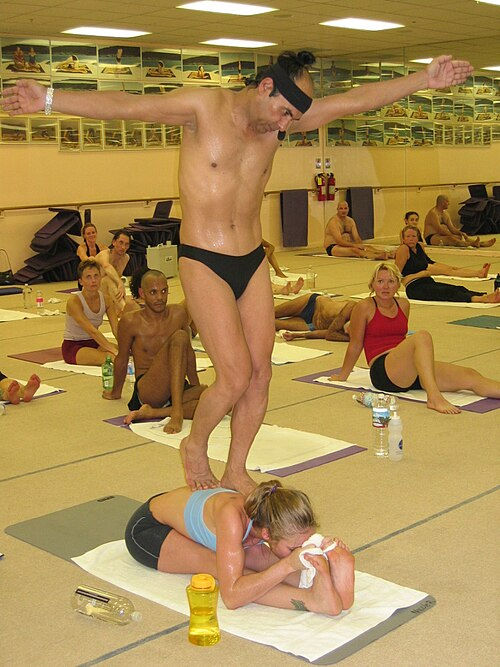
Choudhry did try to argue his specific sequence had aesthetic value, similar to a dance sequence, but the Ninth Circuit still found it to be a system as the primary value of yoga is the usefulness (patent) and aesthetic value (copyright) is secondary.
The compilation of different postures does not change that it is a process. The yoga sequence is more like a recipe for chocolate cookies than the creative choreography of the musical Kiss Me Kate (the first dance registration in the USA).
The U.S. Copyright Office describes yoga poses and sequences as "ordinary motor activities" and thus ineligible for copyright protection.
In summary, yoga is grouped in with gymnastic exercises as functional works while figure skating and dance is grouped under creative works. This can be disheartening for clients who have spent a lot of creative energy on creating a sequence of yoga postures, but this has been strong case law for over 10 years that yoga sequences are different from dance sequences.

Yoga as Patent
To obtain a patent, the invention must be novel and non-obvious. Yoga poses and sequences do not usually meet the "new and unique" standard as postural exercise and meditation has had been around for a long time. Examiners rely on marketplace, academic, and previous patent applications to determine if a new idea, process, or system is really "new."
In response to a number of high profile patent cases at the turn of the century, the India government launched the Traditional Knowledge Digital Library (TKDL). Through the TKDL, the Indian government's aim is to give tools to Examiners to recognize when a yoga sequence is truly "new" or simply a version of something that has existed in the public domain. Whether the library has been effective is unclear as neither the USA or India have published a comprehensive report on their yoga patent refusals.

While patent and copyright may be difficult to obtain for the sequence of postural yoga, the licensing of yoga branding and instruction material is still protectable under intellectual property law. As always, please discuss your specific case facts with an attorney.
Further Reading
Alexander Bussey, Stretching Copyright to its Limit: On the Copyrightability of Yoga and Other Sports Movements in Light of the U.S. Copyright Office's New Characterization of Compilations, 20 Jeffrey S. Moorad Sports L.J. 1 (2013). Available at: https://digitalcommons.law.villanova.edu/mslj/vol20/iss
Allison Fish, The Commodification and Exchange of Knowledge in the Case of Transitional Commercial Yoga, International Journal of Cultural Property (2006). Available at: https://doi.org/10.1017/S0940739106060127
Mark Singleton, Yoga Body: The Origins of Modern Posture Practice, Oxford University Press (2010). Available at: your nearest library
Siddharth Srivastava, What happens when spirit meets wallet? It's patently obvious, Asia Times Online (2005). Available at: http://web.archive.org/web/20070408200341/atimes.com/atimes/South_Asia/GG02Df02.html


Comments