Homemade Board Games: Magical Casting Stones
"Harry Potter Casting Stones" was a board game launched in 2001 by Mattel in connection with the Warner Brother’s Harry Potter and the Sorcerer Stone. Board Game Geek’s average rating of the game is 4 stars out of 10 (Link / Archive). Since the game is only for 2 people, has a lopsided game play, and you must buy multiple packs to have a complete game, I’ve decided to create my own generic version: Magical Casting Stones.
Board Game as Collectable
Harry Potter Casting Stones starter pack consists of 1 game mat, 2 cards (Double Potion, Double Charms), 12 randomized casting stones, 6 green gems, and 6 yellow gems. The casting stones are large, ridged plastic pieces, with a number on one side and an image on the other. They come in 4 colors: light grey (character), white (artifacts), brown (elements), and dark grey (chasers). They are on a scale of 5 rarity: common, uncommon, rare, rare foil, and chaser. The cards presumably vary in rarity, but Mattel never issued a collectable sheet for the cards like they did for the stones.
To find all 125 stones and 70 cards, one must buy more starter packs or the “refill” packages that contain 4 stones and 1 card. Once you buy a refill package and start collecting specific cards, you end up in a situation where you own a card calling for all of Neville Longbottom’s stones, but you do not own a stone that has an image of his frog, Trevor, so that card is useless. The starter game comes with initial instructions and a checklist sheet, encouraging the player to buy more packs to collect all the pieces. From my rough calculations, you would need to purchase at least 73 refill packs to collect everything ((125/(H125 − H12))/4) which at roughly $20 a pack is roughly $1,460.
Mattel took collecting one step further - the stones are collectable for 2 games. The stones may also be used for "Harry Potter and The Sorcerer's Stone Powercaster Electronic Spell-Casting Playset." The "Powercaster" was a toy where 2 players compete in a wizarding duel. Special action figures stood on their respective turret with a screen in-between. Each player would randomly receive their casting stone and then place it on a turret near their action figure. On the screen lights, sounds, and animation would appear before one action figure would fall off their turret, loosing the duel. The action figures were collectible as well as the stones, resulting in a cascade of items a Harry Potter fan must collect to have a complete game.
Harry Potter is a series made for merchandising. Verity Ritchie has a great video essay on capitalism and J.K. Rowling’s creation. Consumerism is a core part of the story, such as shopping on Diagon Alley introducing Harry to the wizarding world, and the snack cart on the train helping to create the friendship between Ron, Hermione, and Harry. In Harry Potter Casting Stones, there are many stones themed after purchasable items, including Bertie Bott's Every Flavour Beans. The shopping and merch element are also fundamental to the theme-parks, eclipsing the roller-coaster element.
The card and stone collecting element is reminiscent of other games like Magic the Gathering or Pokémon. I realize in those games, you aren't expected to collect every item. Part of the fun is visiting a friend who also collects the game pieces so you can mix and then battle. Maybe they do have Trevor the Frog so you can finally play that Neville card. However, it would be time-consuming to set-up and take-down the separate the pieces. From the way the marketing for Harry Potter Casting Stones was written, I don't think the intention was group play. The intention was to encourage more purchasing of their product.
The initial instruction booklet of Harry Potter Casting Stones implies that there were be more editions and more stones to collect. Mattel likely envisioned new stone sets to collect as each movie was released. This never came to pass. Mattel did issue a "Phoenix" edition that came with red and blue gems instead of yellow and green but no one has posted that stone list online so I'm skeptical it was wildly sold (as opposed to just at collector events).
Mattel's trademark registration for CASTING STONES expired in 2009 as they never filed the first renewal. I wonder if they never continued with other versions because the game-play or collectability was unpopular.
Thoughts on Minimalism
I enjoy the gameplay of Harry Potter Casting Stones, but it unsettles me every time I see the long list of stones on the instruction sheet. There’s a persistent itch to chase the missing pieces. Wouldn't a good minimalist be able to see that list and not care, to not see the other pieces as "missing" but just something they don't need? I am a failed minimalist, because every time I see the list, I immediately want to buy more.
Collecting is thrilling because of the chase. Mattel has labeled the ultra-rare stones "chasers," a pun on the Quidditch position and the rush of collecting. This cycle is a trap: it keeps you buying, storing, and chasing for new things, instead of enjoying what you already have. Just look at board game forums of people trying to buy the last few stones to complete their collection; it's stories of a high financial costs and disorganization. The joy in the pursuit is exploited by companies to keep people consuming endlessly. Even though Mattel has ceased making the game, there are still countless sellers on Ebay, Etsy, and elsewhere to feed the desire to collect at prices like $20 per 4 stones, with each site taking their own cut.
A good minimalist would simply walk away from this game. I’ve owned this game since it first came out in 2001, and nostalgia makes it harder to let go. I want to be at peace when I see it sitting on my shelf, not tempted by what I don’t have. I’d like to share it with friends without feeling caught in the trap of collecting. Enter stage left: a homemade version!
On this blog, I've written previously about gaming and minimalism, where I argue that minimalism helps you enjoy and play your games more (see Game Content - Digital Minimalism Guide). This homemade version will mean I play the game more. It's not "fewer items" as I'm replacing one boxed game with another, and end up with some leftover craft supplies, but it is "minimalist" in the sense of a game that sparks joy, doesn't feel like it's weighing on me to buy more, and I use it more.
Creating the Casting Stones
For the stones, I made 132 Casting Stones of 48 different unique images. This is fewer than the 170 unique images in the original game play. I didn't include the Harry Potter character cards, such as James Potter or Galleon, and skipped a few of the ingredients that looked similar. For instance, the Dragon Liver, Eels, Slug, and Snake all look similar from a distance.
The colors of the stones correspond to their category, just like the original game. The color doesn't correspond to the rarity, but it does correspond to number size. Chasers are worth the most at 50 and Elements are worth the least at 1, 2, 3, or 4 points.
I bought 120 disc wooden tokens in 20x7mm size from Etsy seller Cube4me when they had a promotion so I got 132 discs in total and a square token for my "designated dealer" token. I purchased white, natural wood, brown (which is more like a mahogany), and dark grey.
For the images, I used my printer, Canva, and Avery Design Center. I then printed the white, grey, and natural stones on clear 3/4 inch round Avery labels. I really struggled getting the images to print dead center in the labels, so my stones look homemade. For the brown, it's too dark to print on unless you have a printer that can do white ink, so I printed those on white 1/2 inch round Avery labels so you see the brown on the edge but the image is clearly visible. (Avery Presta 94503 and Avery Round 4221 at https://app.print.avery.com/). The font used is Frank Ruhl Library, size 30.
For the Numbers:
1, 2, 3, 4, 5, 6, 7, 8, 10, 15, 20, 50
1 - 4 are white (elements)
5 - 7 are natural wood (familiars)
8 - 20 are mahogany (arcana)
50 are dark grey (chasers)
For the Stones:

Name | Type | Token Allocation |
Sweater | Arcana | 2 |
Potion Bottle | Arcana | 2 |
Brass Scales | Arcana | 3 |
Ink & Quill | Arcana | 2 |
Perseus Constellation | Arcana | 3 |
Dragon | Arcana | 3 |
Troll | Arcana | 2 |
Merpeople | Arcana | 3 |
Centaur | Arcana | 3 |
Book of Dark Magic | Arcana | 5 |
Wand | Arcana | 5 |
Cauldron | Arcana | 5 |
Runes | Arcana | 5 |
Phoenix | Chaser | 1 |
Sorcerer's Stone | Chaser | 1 |
Broomstick | Chaser | 1 |
Three Headed Dog | Chaser | 2 |
Unicorn | Chaser | 2 |
Garlic | Element | 1 |
Music | Element | 1 |
Bezoar | Element | 1 |
Spine of Lionfish | Element | 1 |
Eye of Newt | Element | 2 |
Moonlight | Element | 2 |
Water | Element | 2 |
Love | Element | 2 |
Infusion of Wormwood | Element | 2 |
Root of Asphodel | Element | 2 |
Lightning | Element | 3 |
Gold | Element | 3 |
Silver | Element | 3 |
Sunlight | Element | 3 |
Scarab Beetles | Element | 3 |
Holly | Element | 4 |
Mistletoe | Element | 4 |
Purple Flames | Element | 5 |
Dittany | Element | 5 |
Fungi | Element | 5 |
Cat | Familiars | 3 |
Frog | Familiars | 3 |
Chicken | Familiars | 3 |
Rat | Familiars | 3 |
Eagle | Familiars | 3 |
Dog | Familiars | 3 |
Owl | Familiars | 3 |
Bat | Familiars | 3 |
Snake | Familiars | 4 |
Creating the Character Cards
For the cards, there is no official list. A user on Board Game Geek by the name of Probatski created a list of the titles from years of search: Link / Archive.

Based on the cards I owned and the list of titles, I spent time creating fictional cards for the list before I realized that was a waste of time. While there are 125 stones to collect, to keep the rarity level of the stones for game-play, I would need at least 280 stones. Imagine 280+ stones and 70+ cards on a table where each person has their own game mat. I reduced the number of stones to be more manageable, so I also reduced the number of cards. Eventually, I scrapped the idea of fully re-creating the game, the collecting element just makes it too large.
Another reason in creating my own cards is the original game's use of the cards doesn't make thematic sense. There's a stone called Devil's Snare, but also a card that calls for that stone and other stones. Gryffindors Score is a potion of different stones of Harry getting the snitch, yet his dad's stone is also required. When I created my own, all the cards are characters and the player can call on this character for help, similar to evocation in occult practices.
I created the cards in Canva, printed them on cardstock, and then put them in Magic the Gather sleeve holders so I didn't have to print a backing.

The New Game Play
I printed out the below rules on cards that were laminated so each player had a copy of the rules, their game mat, and their gems to play. The new rules:
Casting runes to divine the future has long been a part of the Wizarding World. Over time, witches, wizards, and other magical beings began casting for fun, and this game was born.
You and your opponents compete by throwing your Casting Stones in pairs, conjuring Spells, Potions, and Charms. Whoever wins the duel may take an action. It is possible for you both to lose. You may call on your magical friends and foes using Character Cards. For 2, 4, or 6 players.
You win the game by having 4 gems in a consecutive row on a castle map.
Set-Up: Everyone gets a game mat and gem bag of their choice. First-player gets dealer token, and, if playing with 4 or 6 players, game direction map. First player draws 3 tokens, then so does everyone in a snake formation (end with 6 tokens). Remaining tokens are deposited in the middle of game-play, The Vault.
Character Cards: Witches rarely work alone. You may play a Character Card to receive help from a familiar, friend, or foe.
To start, deal everyone 3 Character Cards and place the remaining face down in The Vault. Discard goes faceup.
Some cards may allow you to draw multiple cards or steal cards. There is no limit to how many cards you can have in your hand.
A successful potion may allow you to swap your card with the top card of the Vault deck.
To play a card, you must declare it before casting the stones at the start of a turn.
If the card is unsuccessful, it returns to your hand. If you activate the card, it must be discarded and you may draw a new card (unless the card says you may not).
Casting Stones: The casting stones are 2 sided: numbers and images. From lowest numbers to highest are: white (element), familiars (natural wood), arcana (mahogany brown), and chasers (grey). The images vary in rarity.
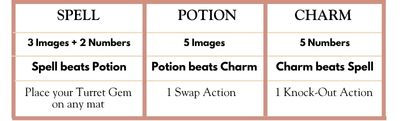
Swap actions:
Swap one gem with another gem, as long as on the same mat.
Swap a Casting Stone in your hand with any from the Vault.
Swap a Character Card with the top Card in the Vault.
Knock-out actions:
Knock-out one of you opponent’s in-play gems into their hand.
Knock-out one of your opponent’s Casting Stones from their hand into the Vault.
Knock-out one of your opponent’s Character Cards into the discard pile.
Duel Rules:
Each turn, you duel your opponent by casting 5 stones (in other words, you shake and deposit the wooden discs like they’re dice).
The opponent you duel with is determined by how many players, see the direction map, but is the same rules as Hearts.
You may re-cast the stones once per hand (aka re-roll).
Spell, Potion, and Charm always beat a Bungle (when you fail to make 1 of the 3, including if one stone fails to fall on either side).
2 Potions are a tie.
If 2 of the same Spell or Charm, then the winner is the one with the highest total of upward-facing numbers.
If you ever have less than 5 stones, you may draw from the Vault before the next hand. You cannot swap the stones mid-duel.
To view the original game details:
Conclusion: It's satisfying to make homemade board games or just improve a base game, but it is time intensive.


Comments